



On September 7th, at the annual West Indian American Day Carnival, a powerful statement built around Haitian pride will move through Eastern Parkway in New York carrying something heavier than fabric. It carries the people behind the work, the lives behind the paperwork, and a question that becomes harder to ignore when their faces are eight meters long.
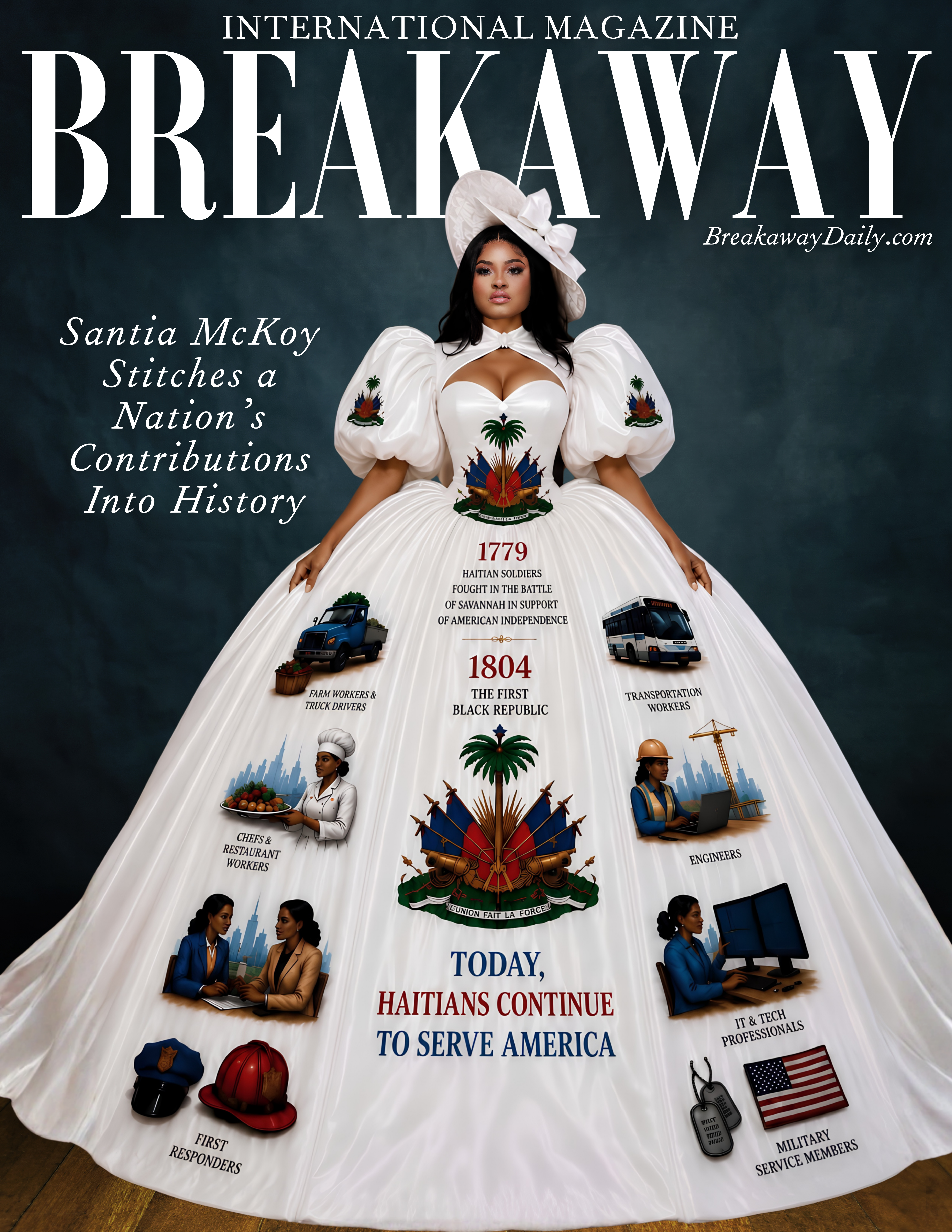
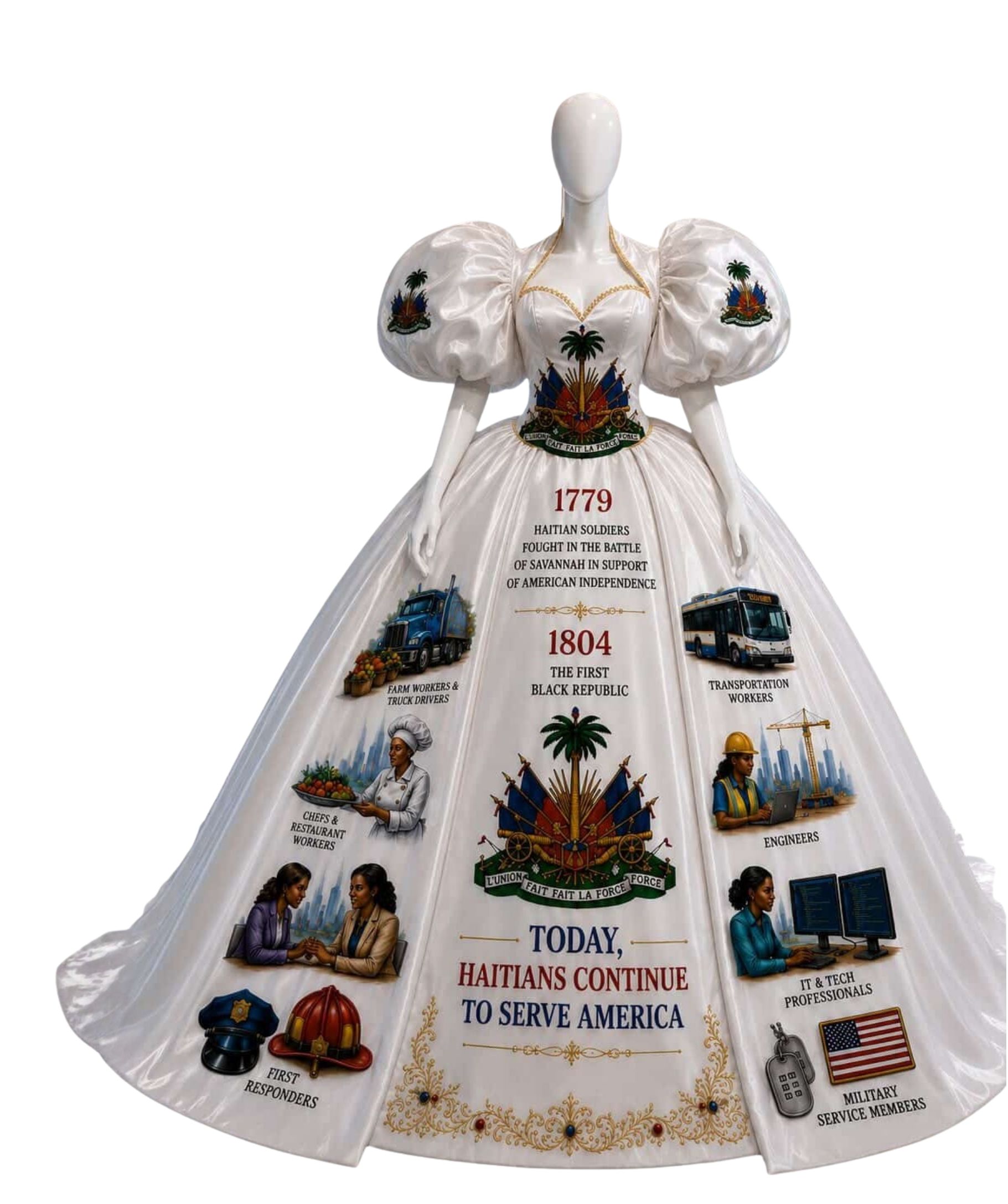
At a moment when the future of Temporary Protected Status (TPS) for Haitians has created profound uncertainty, Santia’s work puts the people behind the headlines at the center. They represent the people of Haiti, rendered in fabric rather than flesh. Beneath each one is the industry they represent. Healthcare. Service. Transportation. IT. Engineers. Military. Construction. The jobs that rarely make headlines but keep cities running.
They are the people who shaped Haiti’s legacy.
THREADS OF RESILIENCE
Designer Santia McKoy put them there for a reason. The gown was commissioned by Haitian Day Parade producer Lionel Lamarre, who approached Santia with a vision he wanted brought to life through fashion. She developed the concept into a detailed design, drew the dress, and sent him the sketch. Two months later, she transformed that original vision into fifty-two yards of symbolic fabric.
The result is a garment that carries both vision and message. Lionel’s concept brought to life through Santia’s design and craftsmanship. Together, they created a piece that tells a story about Haiti, its people, and the labor that has helped sustain American life.
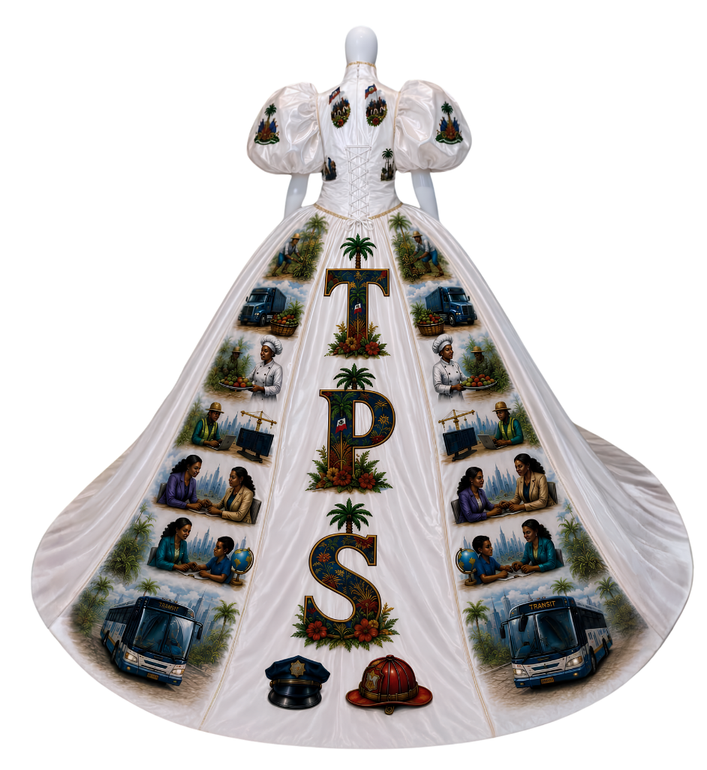
Stitched into the gown are workers whose hands have built, cared for, driven, cooked, repaired and served. Beneath each one, the industry they represent is named: the work that brought them here, the work that kept them here, the work a country needed them to do.
Many of the Haitian workers represented on this piece were protected by Temporary Protected Status (TPS), a federal program that allowed them to live and work legally in the United States while Haiti remained unsafe for return. In July 2026, the Trump administration moved to end those protections, abruptly stripping away the legal status that had allowed them to work and build their lives in America.
They worked. They paid taxes. They raised families. They became part of the machinery of everyday American life.
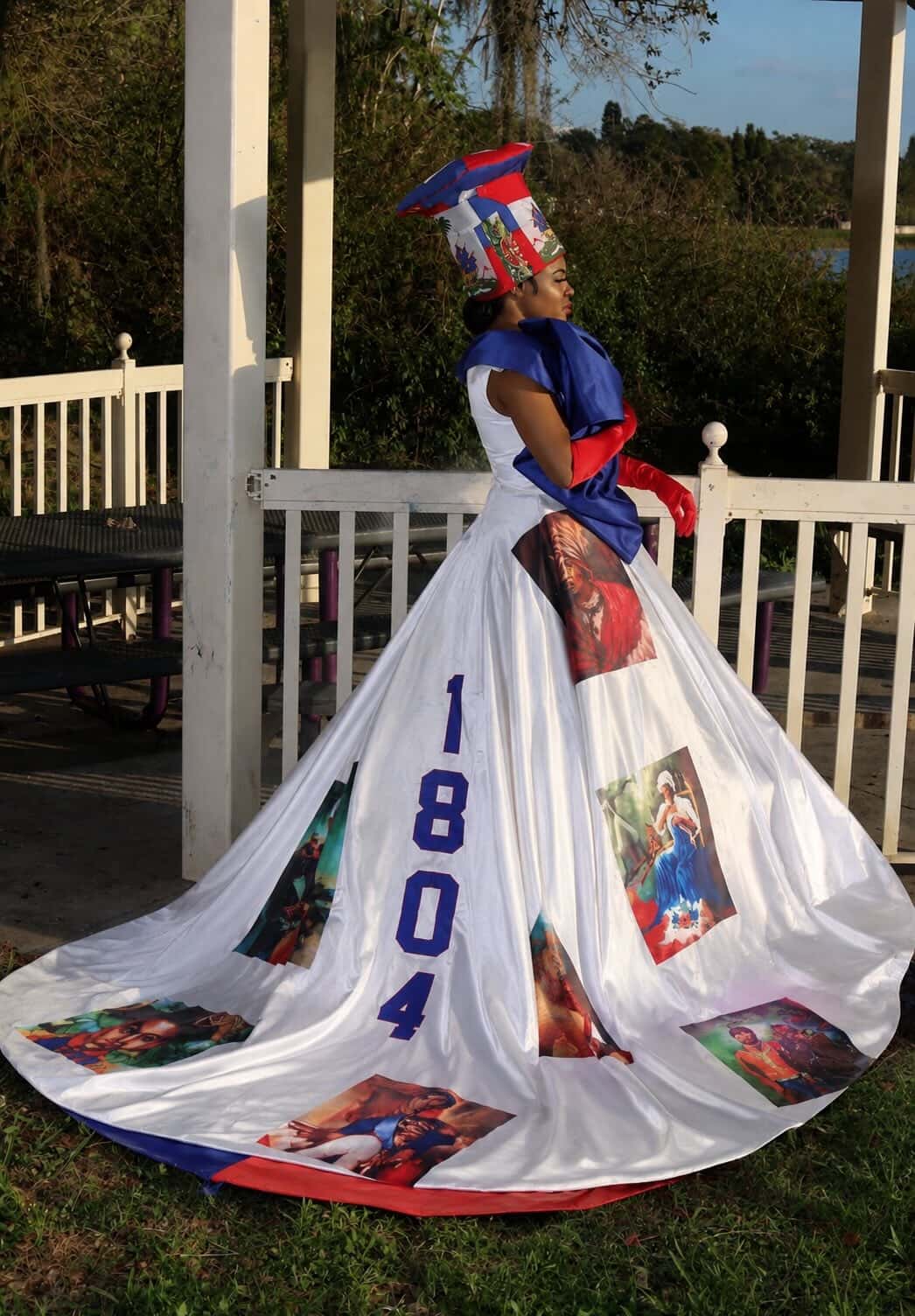
Represented on this gown is a chef, an engineer, a truck driver, medical workers, a soldier in uniform — ordinary people, rendered in fabric, the way a mural renders a neighborhood’s real faces. All these people are professionals held TPS that let them stay in this country legally, for exactly the work stitched onto that dress.
Then the protection began to disappear.
The people did not.
Santia McKoy has symbolically etched their images into the dress, turning the garment into a record of the people whose labor keeps a country moving.
What they are is essential. The almost-invisible workforce keeping a stranger’s grandmother fed, a hospital floor staffed at three in the morning, a warehouse running through a holiday nobody else wants to work. Some have done that work for the better part of two decades. As of this summer, the piece of paper that let them do it legally doesn’t exist anymore.
That’s not an abstraction. Losing work authorization can turn a job into a liability overnight, while removal proceedings become a live possibility for people who didn’t have to think about that risk two months ago. Suddenly, they are one step closer to being sent back to a country some haven’t set foot in for years.
Put that next to Santia’s other dress, one created specifically for this year, pairing Haiti’s 222nd anniversary of independence with America’s 250th, and the connection becomes harder to ignore. When policy reduces people to immigration status, Santia uses fashion to put the people back into the picture.
This year, two countries are counting how long they’ve stood as free nations. One won its independence by defeating a colonial power. The other, Haiti, has spent years with its people working in American hospitals, nursing homes, kitchens and countless other essential workplaces. Now, many of those same workers are facing the loss of the legal protection that allowed them to build their lives there.
Santia didn’t have to invent that history. She just needed fifty-two yards of fabric long enough to hold it.
FASHION AS A LOVE LETTER TO HAITI
As a Haitian designer living in Florida, Santa McKoy draws on her own experiences and identity to create work that brings attention to important social and cultural issues.
Through her social media channels she has a huge Haitian and international audience that she uses to make people look. One dress alone, a red-and-blue piece she built in the wake of Haiti’s anti-kidnapping “Bwa Kale” movement, has drawn millions of views. The numbers matter because they give her a way to put Haiti’s pain in front of people who might otherwise look away.
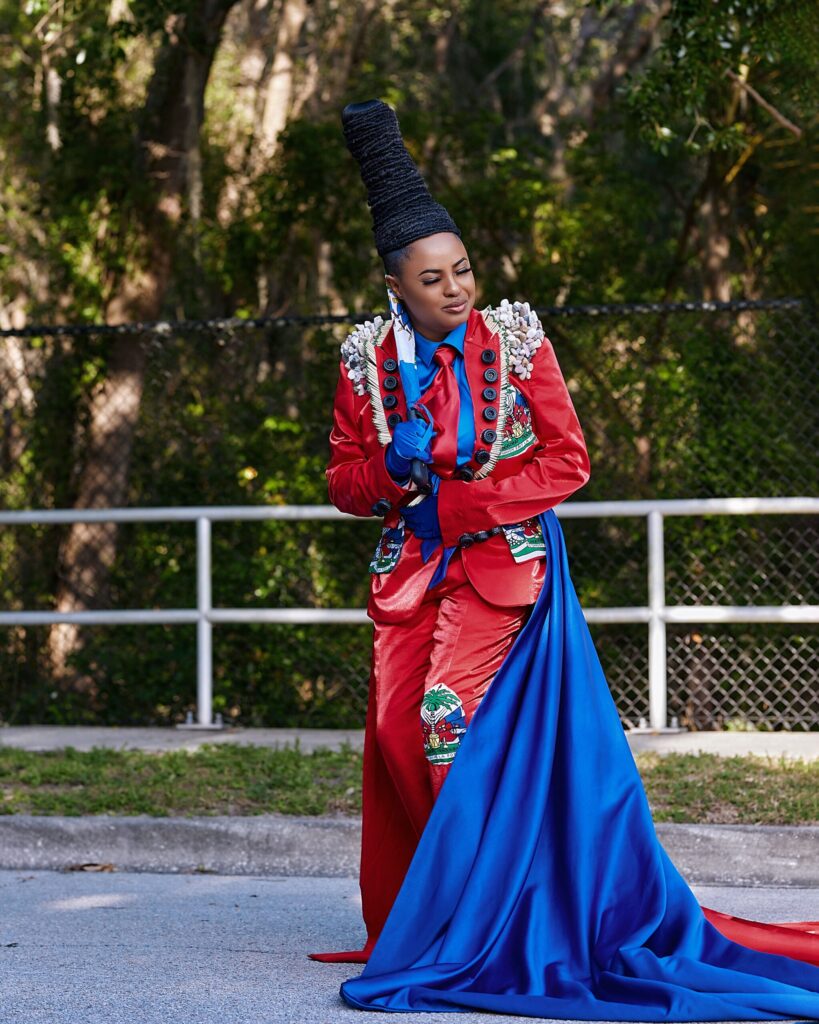
Haitian Designer Santia McKoy Is Raising Awareness of the Haiti Crisis
Read story.
She was born and raised in Haiti, growing up modestly and spending hours as a young girl in her family’s shop, learning to sketch, cut and sew. She lives in Ocoee, Florida, just outside Orlando, where she runs S&M Custom Design with her husband and business partner, Adrian. Together, they are raising four children—three daughters and a son.
What matters is not simply that Santia designs clothes, but what she does with the skills she has spent a lifetime building when something in Haiti breaks her heart. She reaches for fabric, thread and a needle—and finds a way to respond, to process grief, express outrage and make people pay attention. She has done it before, turning what hurts into something made by hand, something that can tell a story that might otherwise go unheard.
Every yard of fabric carries intention.
Every detail carries history.
Every design carries a message.
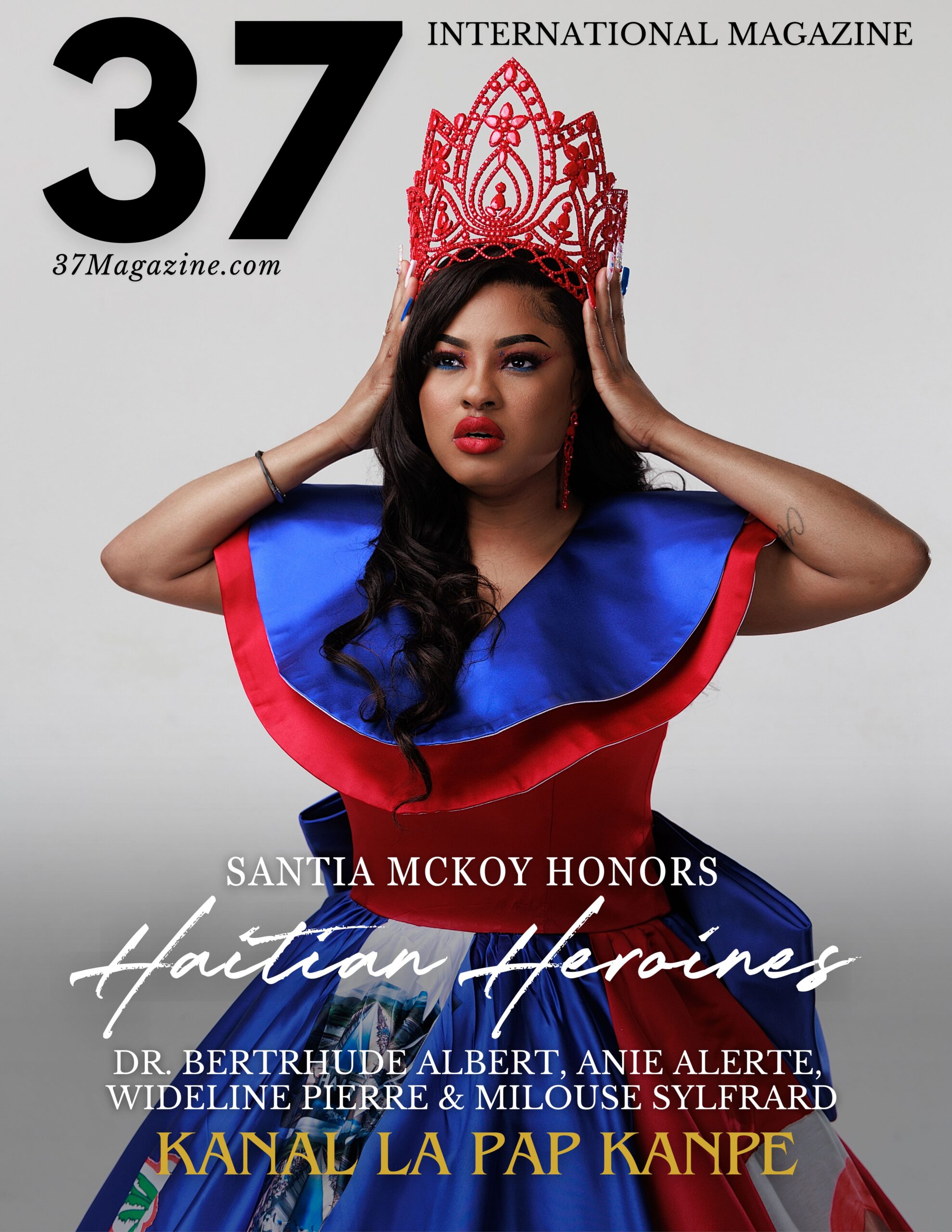
Designer & Activist Santia McKoy Honors the Haitian Heroines of the Canal
Read 37 Magazine Cover Story
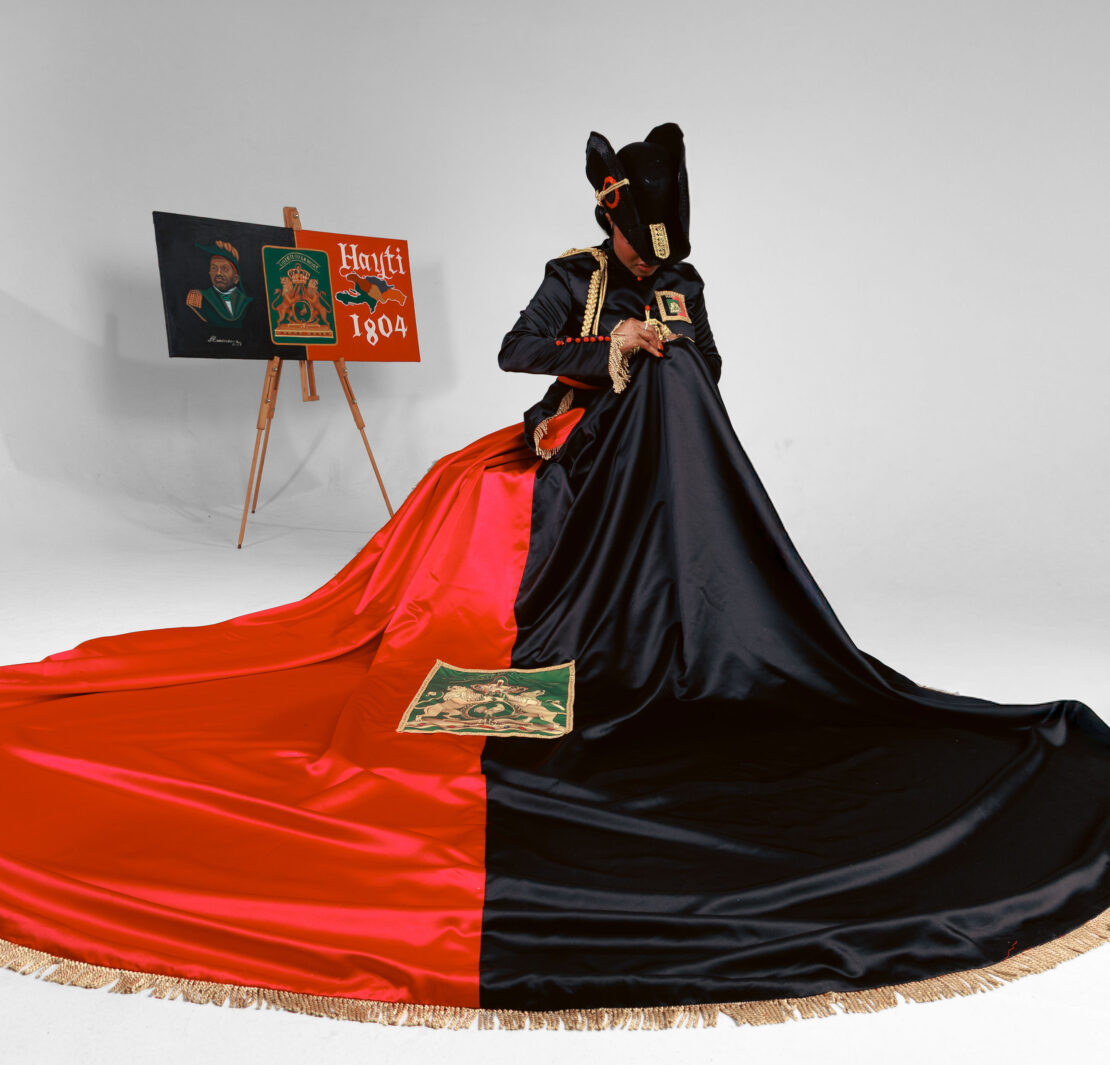
The Unity Wedding Dress in 2021, cut in the red and blue of the Haitian flag, built to transform from ceremony gown into reception piece — “a tribute,” she called it, “to my home country where my dream first began.”
Kanal Rezistans (L’Union Fait La Force) gown paid tribute to four Haitian women who became voices and participants in the canal movement: Dr. Bertrhude Albert, Anie Alerte, Wideline Pierre and Milouse Sylfrard. Their faces joined the workers and the canal itself on the dress, turning the gown into a portrait of Haitian resistance, solidarity and self-determination.
She paired the design with a fashion show that raised awareness and funds for the cause. The message was unmistakable: art could be more than something seen. It could stand for something and impact change.
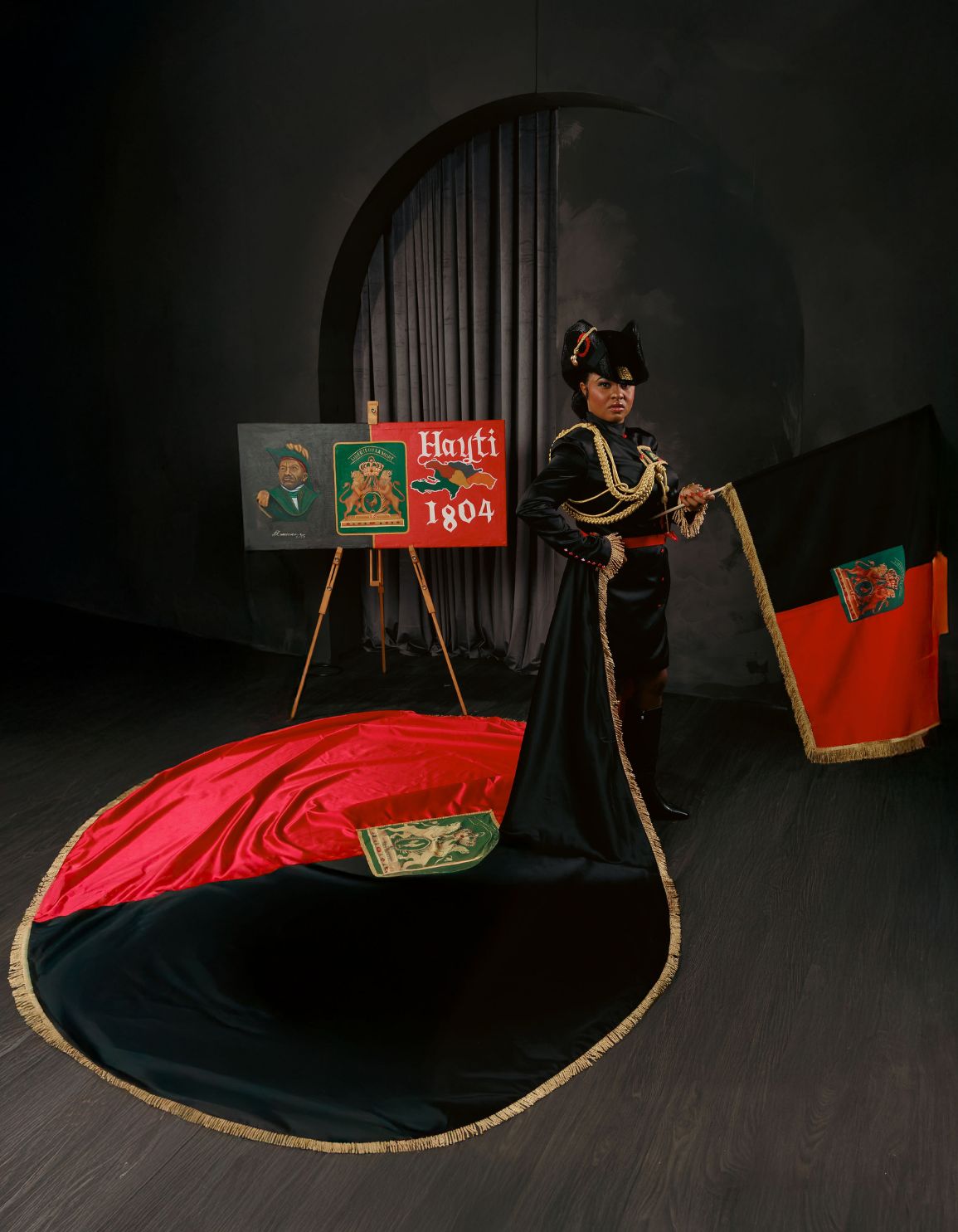
Released on the anniversary of the Battle of Vertières, the 1803 dress commemorated the day in 1803 when Dessalines’s army broke Rochambeau’s forces at Cap-Français and effectively brought French colonial rule in Haiti to an end.
Then, on Haitian Independence Day January 1, 2026—the 222nd anniversary of the declaration that made Haiti the world’s first independent Black republic—she released Impératrice. The title means “Empress,” a deliberate return to the era immediately following independence, when Jean-Jacques Dessalines declared himself Emperor Jacques I. The dress invokes that imperial chapter of Haitian history, shifting the focus from the revolutionary struggle that preceded independence to the question of what Haiti—and its people—were meant to become once freedom had been won.
The Spirit of Vertières & the Flight of Grenadiers: Santia McKoy’s Tribute to Haitian Pride
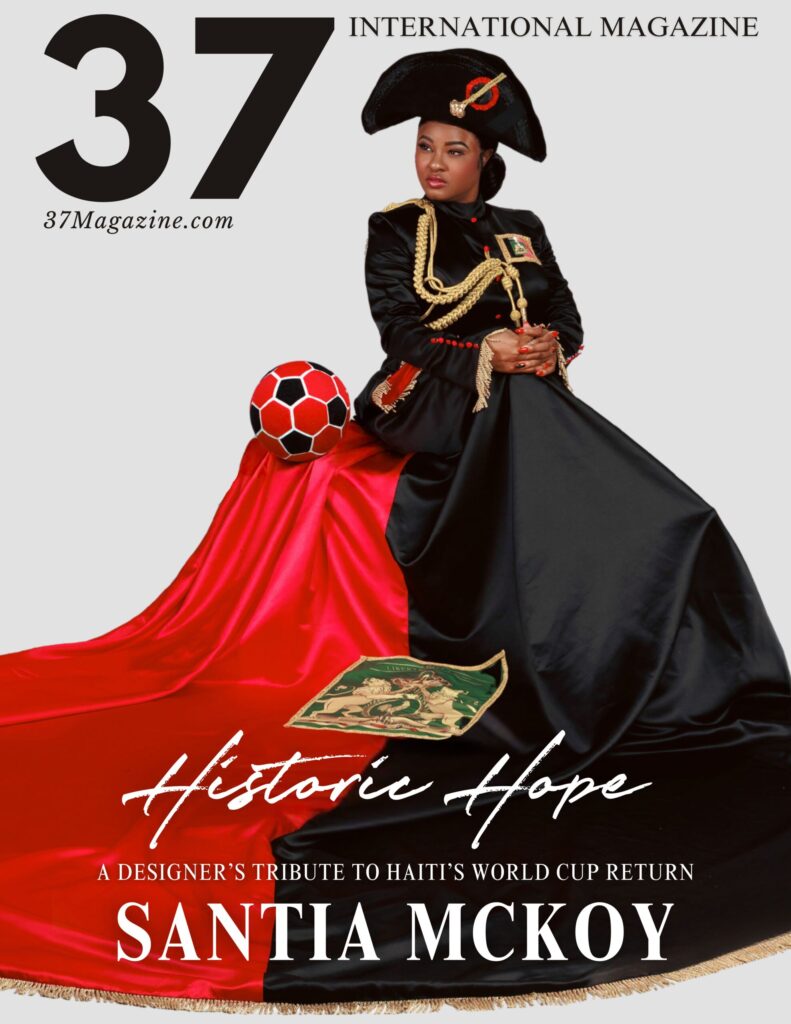
Santia’s Wakanda Forever tribute is inspiring too, drawing a line — not a subtle one — between Afrofuturism’s imagined Black nation and the real one she comes from. “Wakanda is that Haiti we dream of,” she’s said, “the one built at the dimension of its glorious history.”
READ: Designer Santia McKoy Honors Black Panther: Wakanda Forever
During one of the largest Caribbean celebration in North America, those ideas will come to life one after another. Santia will show the Kanal Rezistans, Impératrice, the 1804 Dress honoring Haiti’s heroes, a Dessalines-inspired suit and the Royabel suits, rooted in traditional Haitian dress. She’ll also unveil “Do It for Haiti,” a major statement piece created to speak to the country’s strength, identity and spirit.
None of it was made to hang quietly in a gallery. It was made to speak louder than words — and this year, to walk down Eastern Parkway.
The September presentation isn’t built in one register, either. It moves through traditional Haitian cultural wear, into full couture, into pieces constructed less like garments than like historical documents — before it even gets to the two pieces carrying the real weight of this particular year.
FASHION AS ACTIVISM
When two creative minds collide, history is made.
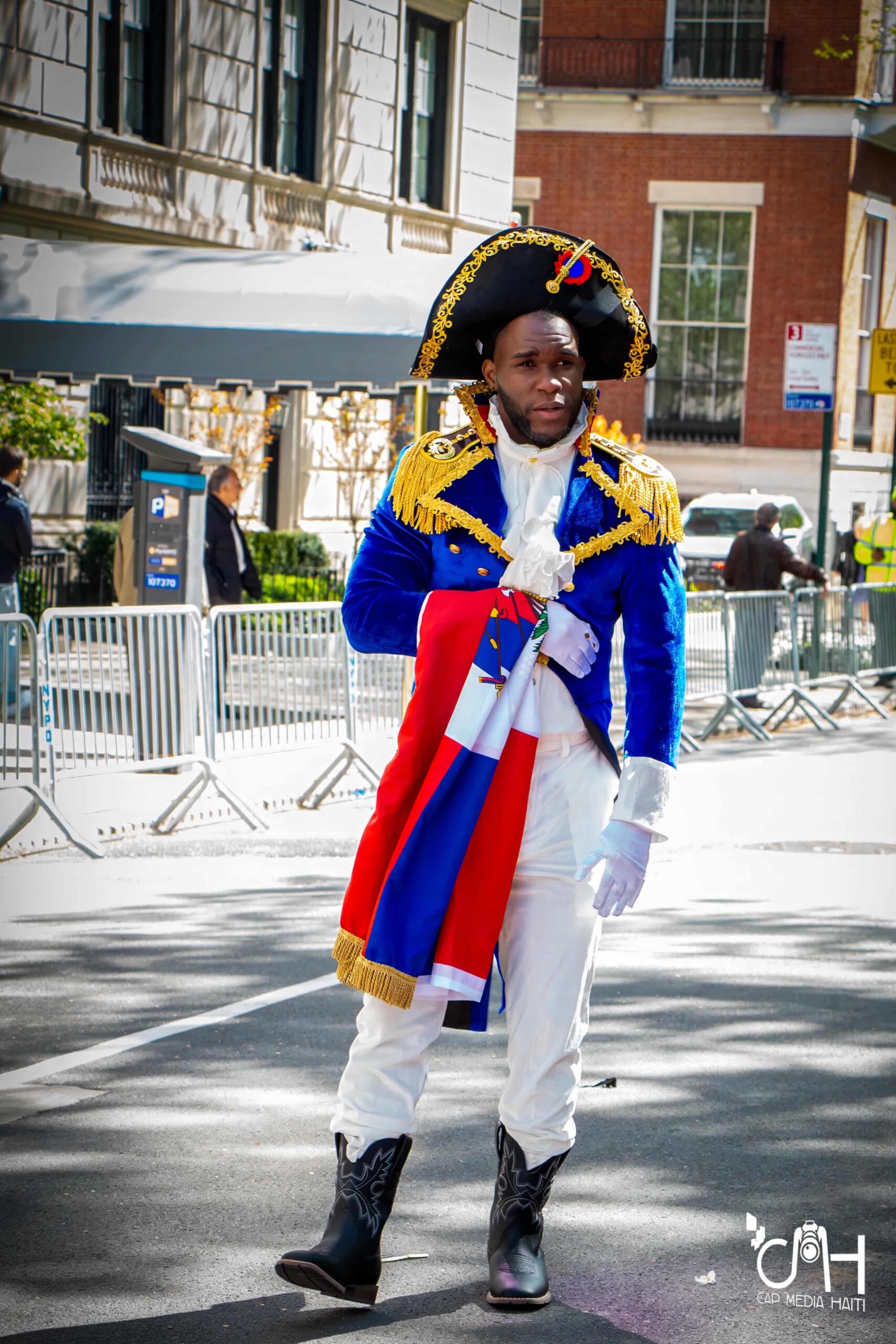
On Labor Day, while a river of nations moves down Eastern Parkway for one of the largest Caribbean carnivals in North America, a Florida designer is walking two arguments through the crowd — one sewn from fifty-two yards of fabric, the other cut for a legal status this country just took away.
The vision for the dress began with parade producer Lionel Lamarre, who approached designer Santia McKoy to bring his concept to life. After discussing his vision, McKoy developed the design, drew the dress, and sent him the sketch. Two months later, she brought that original vision to life in fabric.
The resulting collaboration between Santia and Lionel is more than a partnership — it is the collision of two creative minds determined to use fashion, history, and culture to tell Haiti’s story with dignity and power.
“I have watched the Haitian diaspora show up for the celebration year after year,” explains Lionel. “From Brooklyn to Long Island. This year, brought to life through Santia’s design and craftsmanship, takes the form of a dress created to send a message to the world about who Haitians are and what Haitian people have contributed to this country.”
“This September will mark my third collaboration in New York with the Haitian Day Parade team,” says Santia. “Our first collaboration took place on April 16, 2026, during the Greek Parade in New York. Our second presentation was with the Haitian Day Parade in Long Island. Both presentations were successful, generating media attention and demonstrating the impact Haitian fashion can have when our culture is presented with intention, creativity and pride.“
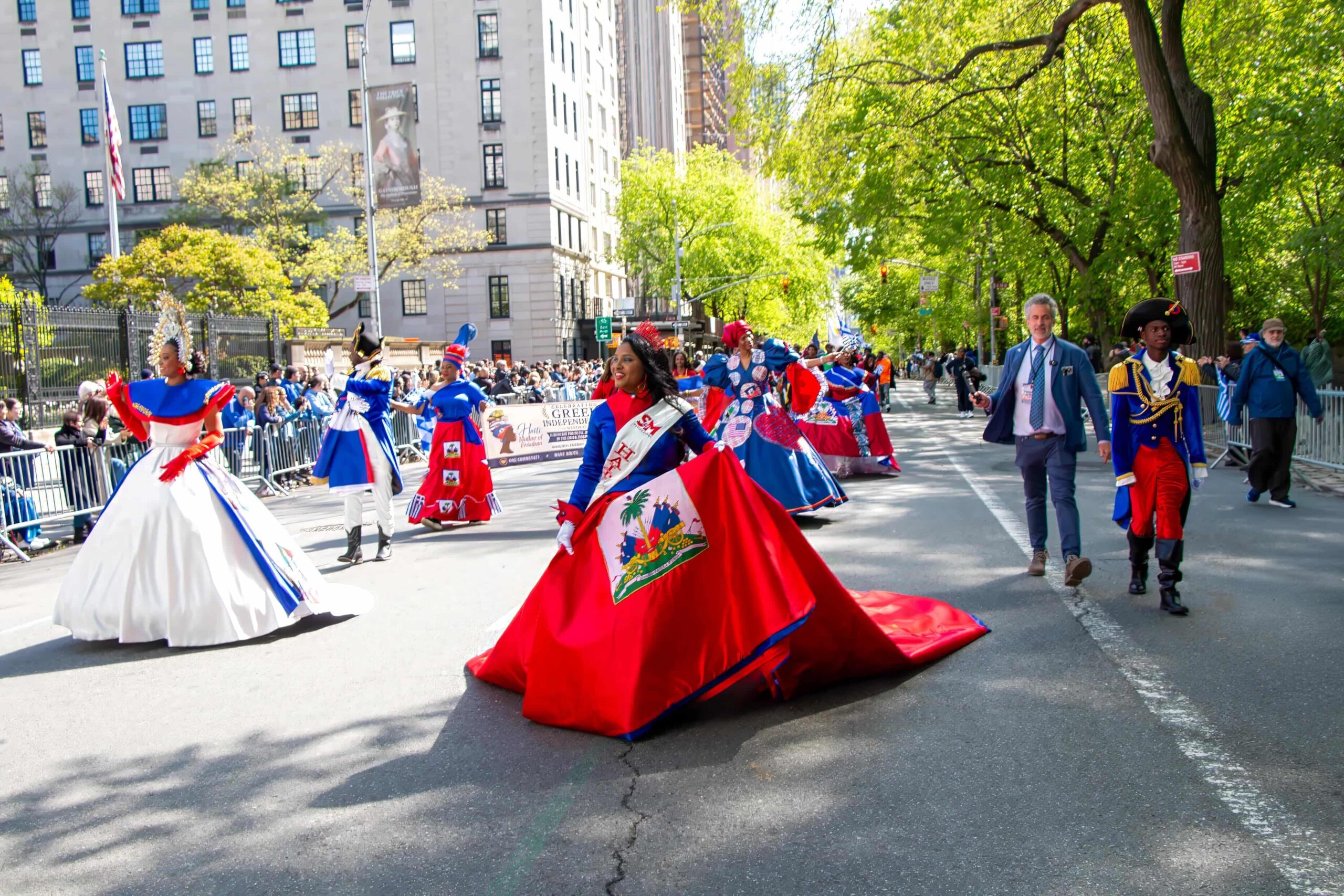
MAKING A STATEMENT
Haiti through history, culture & couture.
“For our September presentation, we are taking the vision to another level. This will not simply be a collection of beautiful dresses. Every garment has a purpose. Every design carries a message. Every look tells its own story. The presentation will feature different dimensions of Haitian fashion, including traditional cultural clothing, high fashion, couture and historical storytelling pieces.”
Among the major statement pieces will be the Haitian TPS Dress, created to represent the Haitian community and highlight the contributions Haitians have made to the United States.
According to an analysis by FWD.us, Haitian TPS holders contributed an estimated $5.9 billion to the U.S. economy each year and paid roughly $1.56 billion in federal, payroll, state and local taxes. More than 300,000 Haitian TPS holders were living in the United States in the data used for that analysis, with workers filling jobs in healthcare, food service, transportation, retail, manufacturing and other essential industries.
McKoy’s answer was not a speech. It was a work of art. And on Labor Day, as that dress moves down Eastern Parkway in celebration of Haiti, the workers will move with it. Their industries will be written beneath them. Their bodies will be part of the fabric. What was once paperwork will become something impossible to file away.
A number.
A worker.
A Haitian.
A human being.
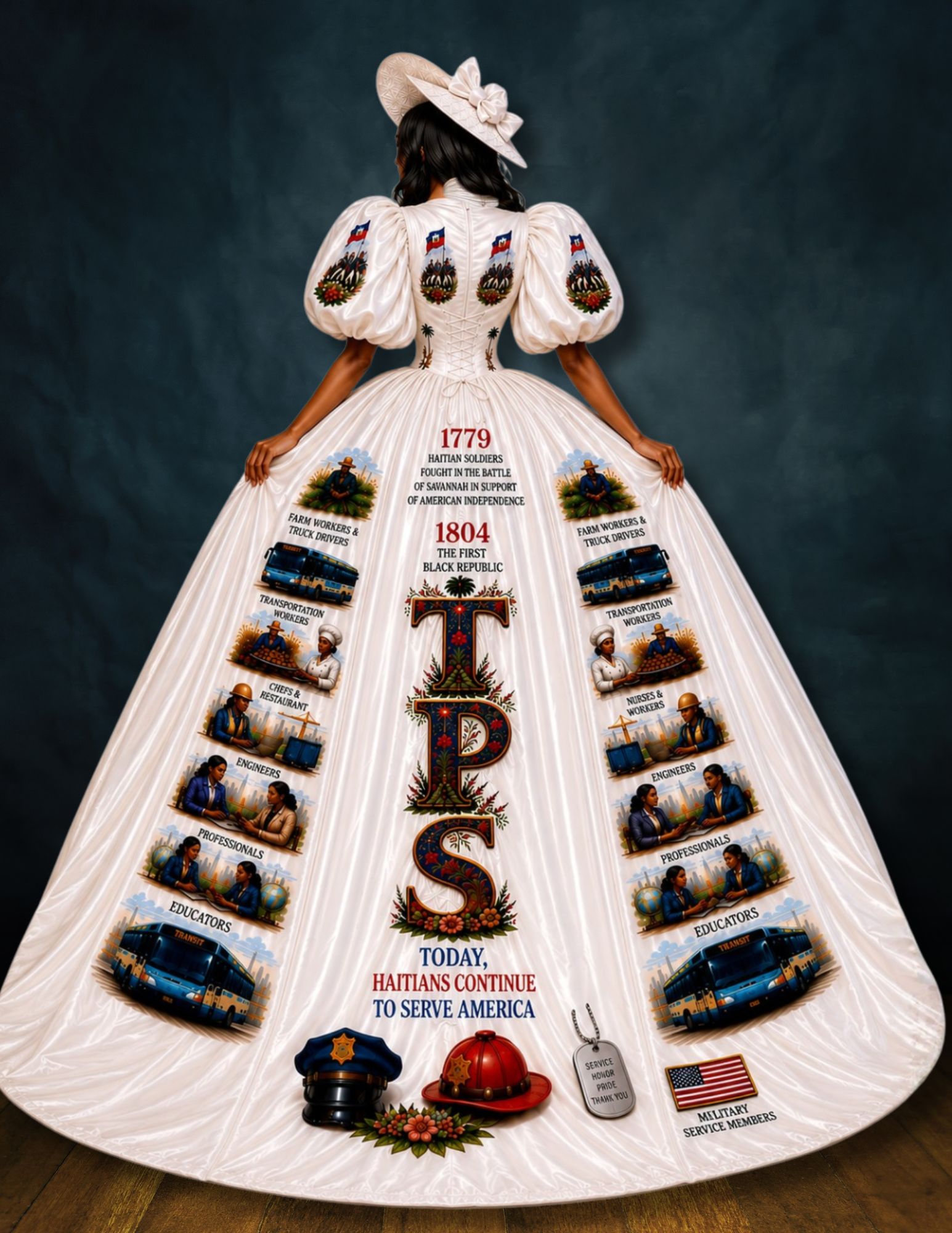
So when Santia says the TPS Dress is meant to “send a message,” she isn’t being poetic. She’s responding to the real-world stakes of Haitian TPS.
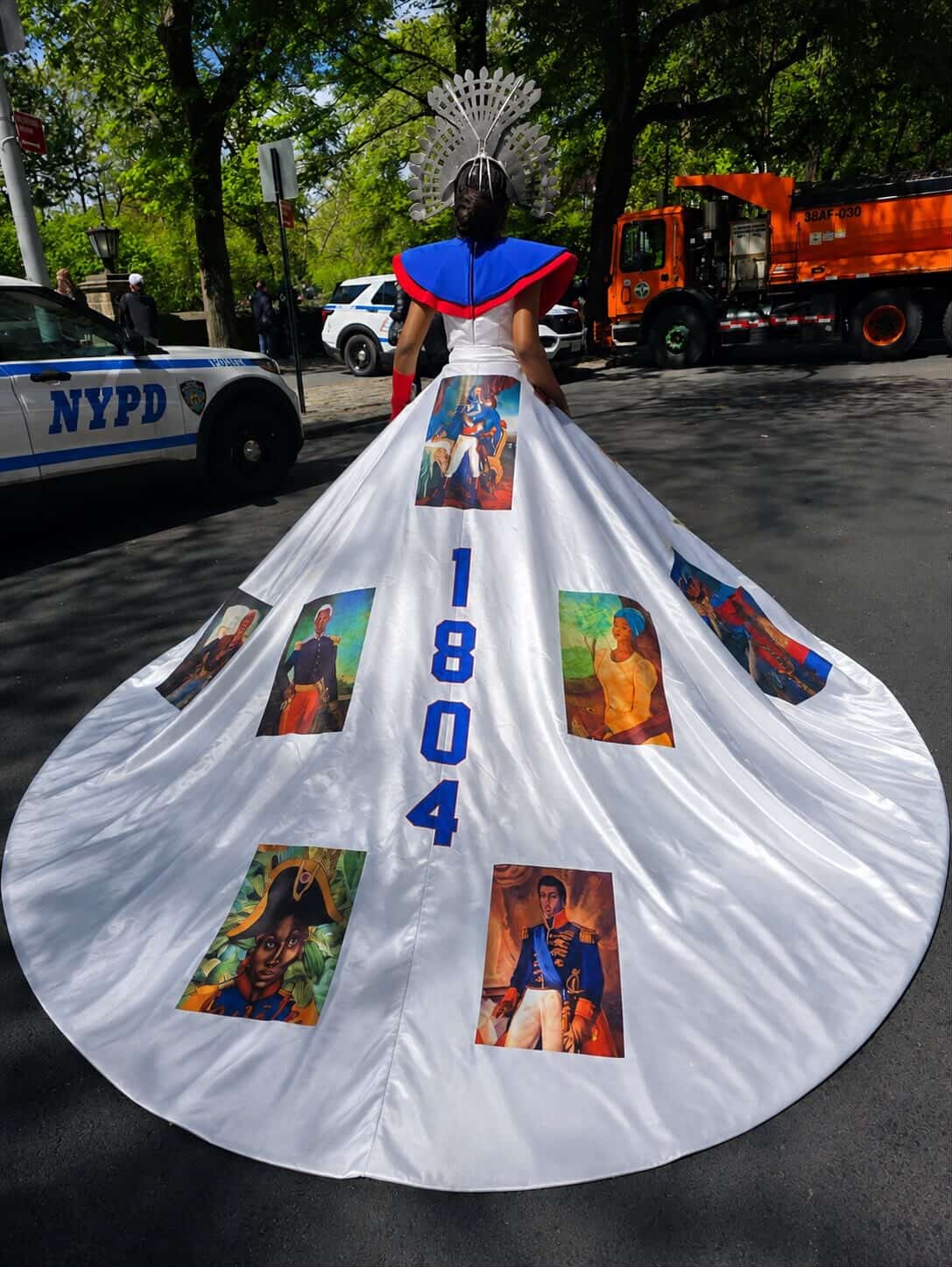
Picture the piece itself. Down the bodice, across the skirt, she’s rendered in fabric, illustration-style, the people TPS status actually belonged to. Transportation workers. Engineers. Chefs, standing over the exact kind of kitchen that quietly feeds a hundred American cities on a Tuesday night. Farm workers. IT technicians. First responders. Military. Featured prominently through the piece, a date: 1804. And elsewhere on the gown, its answer, present tense: today. If you had to compress the whole argument of the dress into one line, it’d be something like — this didn’t start with a headline six months ago. It’s been running the length of a country’s entire existence.
“When others attempt to portray Haitians through racist stereotypes or degrading narratives, our work challenges those images with something far more powerful: our own story, told by us.”
That’s the real ambition sitting underneath the sequins — not just marking a policy loss, but refusing somebody else’s version of who Haitians are. The version they’re handing back is the one already stitched down the front of the TPS gown: builders. Workers. Creators. Taxpayers. Entrepreneurs. People, not a punchline.
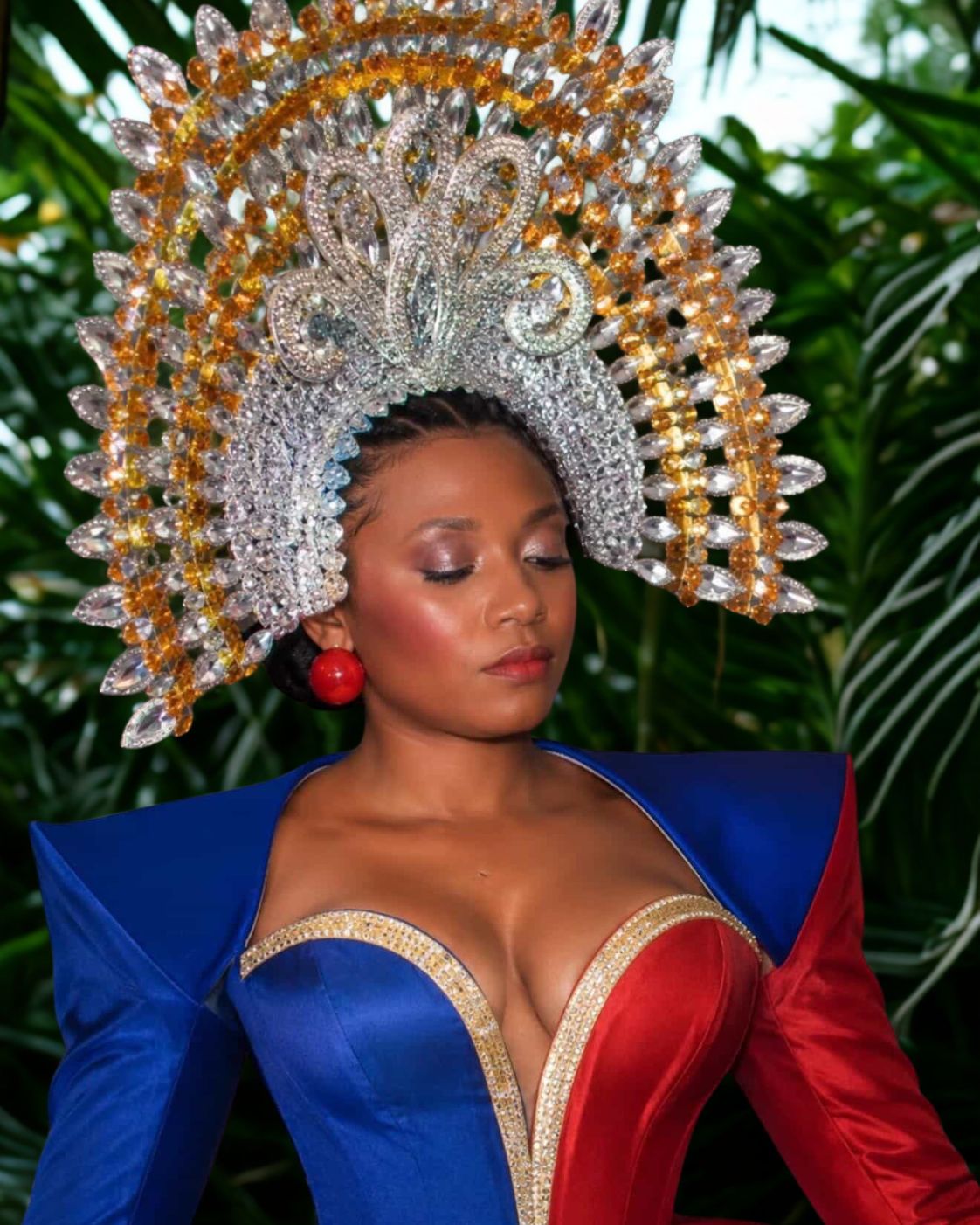
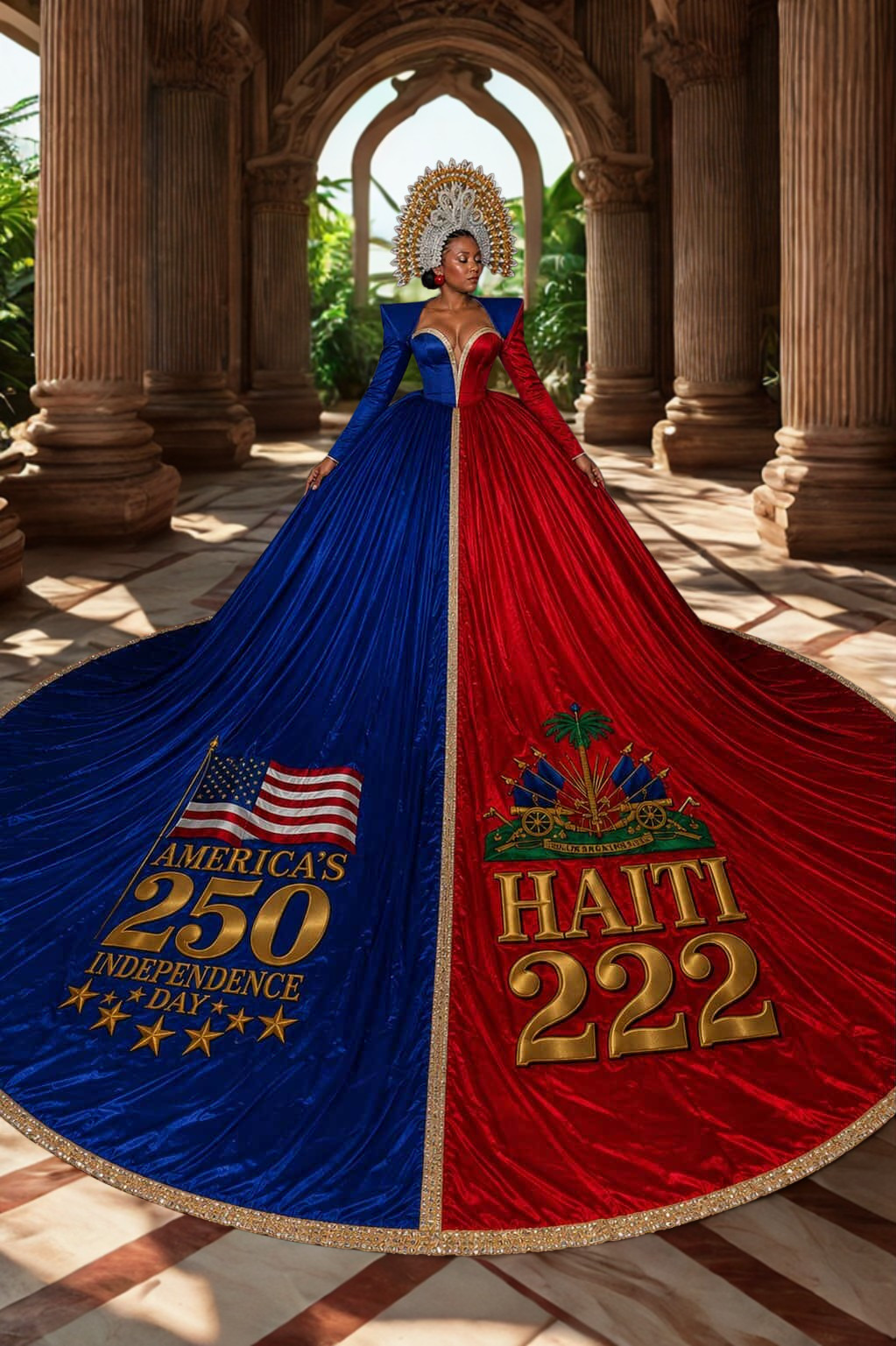
AMERICA 250 · HAITI 222
250 years of America & 222 years of Haiti.
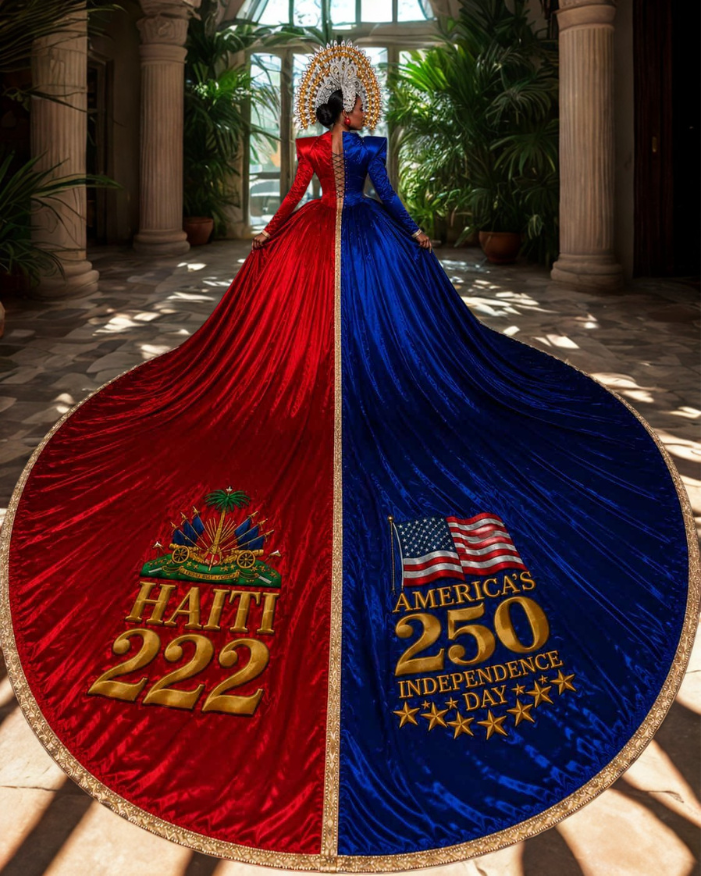
America 250 & Haiti 222 Independence Dress is a powerful piece connecting the 250th anniversary of American independence with Haiti’s 222nd year of independence in 2026.
It’s a gown that puts “America 250” across the table from “Haiti 222” — the United States marking two hundred fifty years of independence this year, Haiti marking two hundred twenty-two of its own, both numbers landing, by the accident of history, in the same calendar year.
Santia built it with an eight-meter train and north of fifty-two yards of fabric, which, if you’ve never stood next to that much fabric in motion, is genuinely a lot to move down a parkway. It’s the most ambitious piece in a collection full of ambitious pieces, and she knows it.
Haiti became the first nation in the Western Hemisphere born of a successful slave revolt on January 1st, 1804, weeks after Dessalines’s forces beat the French at Vertières. Two hundred twenty-two years later, the message stitched into this dress isn’t just about the number itself. It’s about what the number symbolizes: a nation born from resistance, built by people who fought to make themselves free, and still demanding to be seen on its own terms.
Unity, recognition and compassion” is the phrase attached to the piece — compassion, specifically, for people who work the jobs, pay the taxes, build the businesses, raise the kids, and generally handle the unglamorous daily labor of being American while the paperwork underneath them keeps shifting.
A NEEDLE, A NATION, A STORY
Clothes have never stopped a policy. But they’ve done something a policy can’t: they’ve turned people who might otherwise be reduced to a line in a federal notice back into human beings. A chef. A nurse. A soldier. A driver. People who have spent years feeding, caring for, building and moving a country that rarely stops to look at who is doing the work.
Haiti didn’t ask permission to become a country. Two hundred twenty-two years on, it isn’t asking permission to be remembered as one, either.
That is what Santia McKoy is asking these dresses to do. To put workers where statistics usually live. To put Haitian history where stereotypes have been. To take stories that could be reduced to a headline, a policy decision or a number and give them a face, a body and eight meters of fabric to move through the streets.
“We are not asking the world to rewrite our history for us. We are using our art to make sure our istory cannot be erased, distorted, or forgotten.”
Discover Santia McKoy’s latest designs, Haitian-inspired couture and the stories woven into every piece at SMCustomDesign.com
Go Deeper With Breakaway
Stories like this remind us that culture, history, and identity are never separate. Subscribe to Breakaway Magazine for more thoughtful features, interviews, and cultural stories that go beyond the headlines—and help support the independent journalism that makes them possible.
If you are interested in being featured in a story please contact us at magazine@breakawaydaily.com